In today’s competitive landscape, businesses can no longer rely on broad assumptions about their audience. Customers expect relevant offers, personalized experiences, and messaging that speaks directly to their needs—something every strong digital marketing strategy should prioritize. That’s where a powerful customer clustering strategy becomes a game changer, helping brands align data insights with smarter digital campaigns and targeted customer engagement.
Instead of treating your entire audience as one group, clustering allows you to uncover meaningful patterns in your customer data—an approach that also supports smarter SEO optimization strategies by helping you target the right audience segments with relevant content. With techniques like K-means clustering, you can build a powerful customer segmentation model that improves market segmentation and strengthens your personalization strategy.
This guide walks you through what customer clustering is, how K-means works, and how to apply it effectively in your business.
What Is a Customer Clustering Strategy?
A customer clustering strategy is a data-driven approach to grouping customers based on shared characteristics. These characteristics can include:
-
Purchase behavior
-
Frequency of transactions
-
Average order value
-
Demographics
-
Website interactions
-
Product preferences
Instead of manually defining segments, clustering uses algorithms to detect natural groupings within your data. This approach removes bias and reveals hidden patterns that traditional market segmentation may miss.
The result? Smarter decisions, sharper targeting, and higher ROI.
Why Traditional Market Segmentation Falls Short
Traditional market segmentation typically relies on broad categories such as age, gender, or location. While helpful, these categories don’t always explain behavior.
For example:
-
Two customers of the same age may have completely different spending habits.
-
Customers in the same city may interact with your brand in very different ways.
A data-driven customer segmentation model looks beyond surface-level demographics and focuses on actual behavior. That’s where K-means clustering comes in.
What Is K Means Clustering?
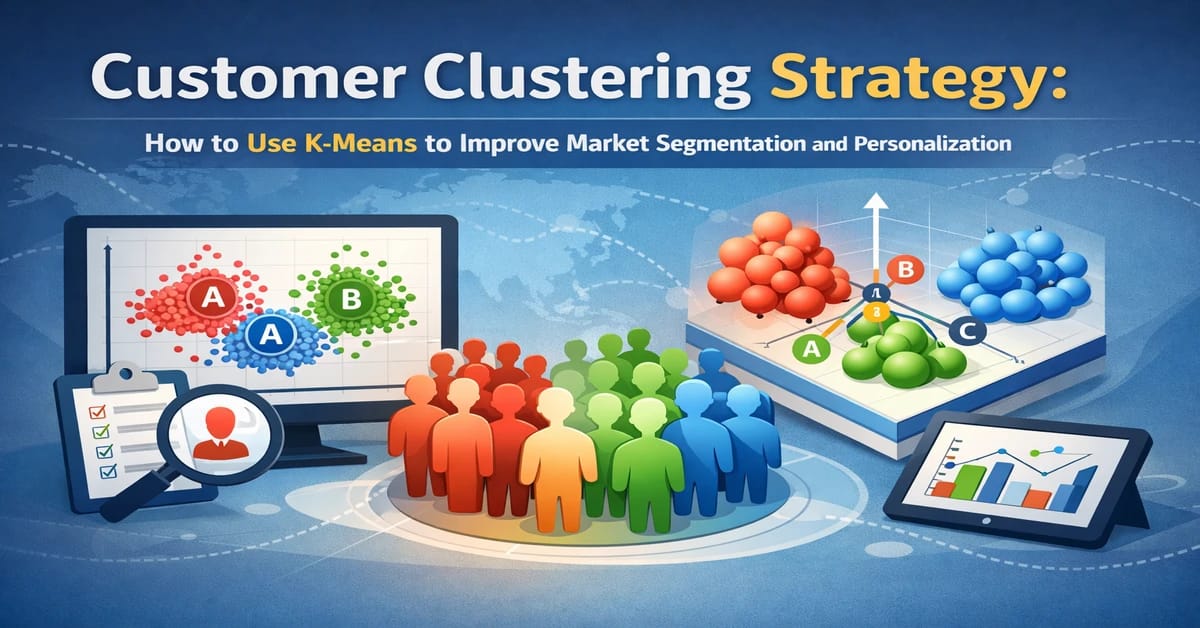
K means clustering is an unsupervised machine learning algorithm used to group data points into clusters based on similarity.
Here’s how it works in simple terms:
-
You choose the number of clusters (K).
-
The algorithm randomly assigns cluster centers.
-
Each customer is assigned to the nearest cluster center.
-
The algorithm recalculates the cluster centers.
-
Steps 3 and 4 repeat until the clusters stabilize.
The goal is simple: minimize the distance between customers within the same cluster while maximizing differences between clusters.
Because K-means is efficient and scalable, it works well for businesses with large datasets.
Step by Step: Building a Customer Segmentation Model Using K Means
Let’s break this down into practical steps.
Step 1: Define Your Objective
Start with a clear goal. Ask yourself:
-
Do you want to improve retention?
-
Increase average order value?
-
Personalize marketing campaigns?
-
Identify high-value customers?
Your objective determines which data points you include in your model.
Step 2: Collect and Prepare Customer Data
Your clustering results are only as good as your data. Common variables include:
-
Recency (how recently a customer purchased)
-
Frequency (how often they buy)
-
Monetary value (how much they spend)
-
Product categories purchased
-
Engagement metrics (email clicks, website visits)
Clean your data by:
-
Removing duplicates
-
Handling missing values
-
Standardizing numerical variables
Data scaling is critical because K-means relies on distance calculations. Without scaling, large numbers can distort results.
Step 3: Choose the Right Number of Clusters
Selecting the right “K” is one of the most important steps in your customer clustering strategy.
Two popular methods help determine this:
-
Elbow Method – Look for a point where adding more clusters provides diminishing returns.
-
Silhouette Score – Measures how well customers fit within their cluster.
Avoid choosing too many clusters. You want actionable segments, not unnecessary complexity.
Step 4: Run K Means Clustering
After selecting K, run the algorithm using tools like:
-
Python (scikit-learn)
-
R
-
SQL-based analytics platforms
-
BI tools like Tableau or Power BI
The algorithm will assign each customer to a cluster. Now the real work begins—interpreting the segments.
Step 5: Analyze and Label Your Clusters
This step transforms raw data into strategic insight.
You might discover segments like:
-
High-value loyal customers
-
Discount-driven buyers
-
Inactive or churn-risk customers
-
New customers with growth potential
Give each cluster a meaningful label. This makes it easier for marketing, sales, and leadership teams to act on the insights.
Turning Clusters into a Winning Personalization Strategy
Data alone doesn’t drive growth. Action does.
Here’s how to use your customer segmentation model to strengthen your personalization strategy:
1. Tailor Marketing Campaigns
Instead of sending one email campaign to everyone, create targeted messaging for each cluster.
For example:
-
Reward loyal customers with exclusive previews.
-
Offer discounts to price-sensitive segments.
-
Send re-engagement campaigns to inactive customers.
Targeted campaigns consistently outperform generic ones.
2. Improve Product Recommendations
Use cluster insights to personalize product suggestions.
If one cluster frequently buys premium products, recommend high-end items. If another group prefers budget options, highlight value deals.
Personalized recommendations increase conversion rates and customer satisfaction.
3. Optimize Pricing Strategy
Clusters reveal price sensitivity patterns. You may discover:
-
One segment rarely buys without discounts.
-
Another segment prioritizes convenience over price.
These insights allow you to test dynamic pricing or targeted promotions.
4. Strengthen Customer Retention
Clustering helps identify churn risks early.
If a group shows declining purchase frequency, intervene with loyalty rewards or proactive outreach. Preventing churn costs far less than acquiring new customers.
Common Mistakes to Avoid in Customer Clustering
Even a strong clustering model can fail if executed poorly. Watch out for these common mistakes:
Ignoring Business Context
Data should guide decisions, not replace strategy. Always align clusters with business goals.
Overcomplicating the Model
More variables don’t always mean better results. Focus on meaningful metrics.
Failing to Update Clusters
Customer behavior changes over time. Re-run K-means periodically to keep your market segmentation accurate.
Not Activating Insights
Clustering without action is wasted effort. Ensure marketing and sales teams use the segments.
Real-World Example
Imagine an ecommerce brand analyzing 100,000 customers.
After applying K-means clustering, they discover four segments:
-
High-frequency, high-spend customers
-
Seasonal shoppers
-
Discount-driven buyers
-
One-time purchasers
By tailoring campaigns to each group, they:
-
Increased repeat purchases by 18%
-
Reduced churn by 12%
-
Improved email click-through rates by 25%
The difference wasn’t more advertising spend. It was smarter segmentation powered by a clear customer clustering strategy.
Why Customer Clustering Strategy Is a Competitive Advantage
Businesses that use data-driven market segmentation outperform those relying on intuition alone. When you understand how customers naturally group themselves, you can:
-
Allocate marketing budgets more effectively
-
Create hyper-targeted campaigns
-
Increase customer lifetime value
-
Improve overall customer experience
K-means clustering provides a scalable, practical way to uncover these insights. It transforms raw customer data into strategic clarity.
Final Thoughts
A well-executed customer clustering strategy bridges the gap between raw data and real business growth. By leveraging K-means clustering, you can build a powerful customer segmentation model that enhances market segmentation and strengthens your personalization strategy.
Start small. Focus on clean data. Choose meaningful variables. Most importantly, turn insights into action.
When you truly understand your customers—not as one large audience, but as distinct behavioral groups—you unlock the ability to deliver experiences that feel personal, relevant, and valuable.
And in today’s market, personalization isn’t optional. It’s essential.
Frequently Asked Questions (FAQs)
1. What is a customer clustering strategy?
A customer clustering strategy is a data-driven method of grouping customers based on shared characteristics such as purchase behavior, frequency, spending patterns, and engagement levels. Instead of relying on assumptions, businesses use algorithms like K-means clustering to uncover natural customer segments. This approach improves targeting, marketing efficiency, and overall decision-making.
2. How does K means clustering work in customer segmentation?
K-means clustering works by dividing customers into a predefined number of clusters (K) based on similarity. The algorithm assigns customers to the nearest cluster center, recalculates the center, and repeats the process until stable groupings form. Businesses use this method to build a reliable customer segmentation model that supports better market segmentation and personalization strategy execution.
3. What data is needed to build a customer segmentation model?
To build an effective customer segmentation model, businesses typically use:
-
Recency (last purchase date)
-
Frequency (purchase count)
-
Monetary value (total spend)
-
Product preferences
-
Website or email engagement data
-
Demographic information
Clean, well-structured data is essential for accurate clustering results.
4. How many clusters should I choose in K means clustering?
There is no fixed number of clusters that works for every business. Most companies use techniques like the Elbow Method or Silhouette Score to determine the optimal number. The goal is to create segments that are meaningful, actionable, and aligned with business objectives—not overly complex.
5. What is the difference between traditional market segmentation and customer clustering?
Traditional market segmentation often relies on broad categories like age, gender, or location. A customer clustering strategy, however, uses behavioral and transactional data to identify natural groupings. This makes clustering more precise and effective for creating targeted personalization strategies.