Expanding a business is more than just opening new locations—it’s about opening the right locations. Understanding where your customers live, work, and shop is critical to ensuring growth, profitability, and long-term success. This is where a geographic clustering strategy comes into play, a skill you can enhance through a digital marketing course with internship and placement opportunities digital marketing course with placement opportunities. gain practical, hands-on experience in location-based analytics.
By combining data analysis with location intelligence analytics, businesses can make informed decisions about site selection, territory planning, and customer targeting. Whether you’re a retail chain, restaurant franchise, or service provider, leveraging geographic clustering can significantly improve your territory planning strategy and guide effective store location analysis.
In this article, we’ll explore what geographic clustering is, why it matters, and how to implement it effectively for business expansion.
What Is a Geographic Clustering Strategy?
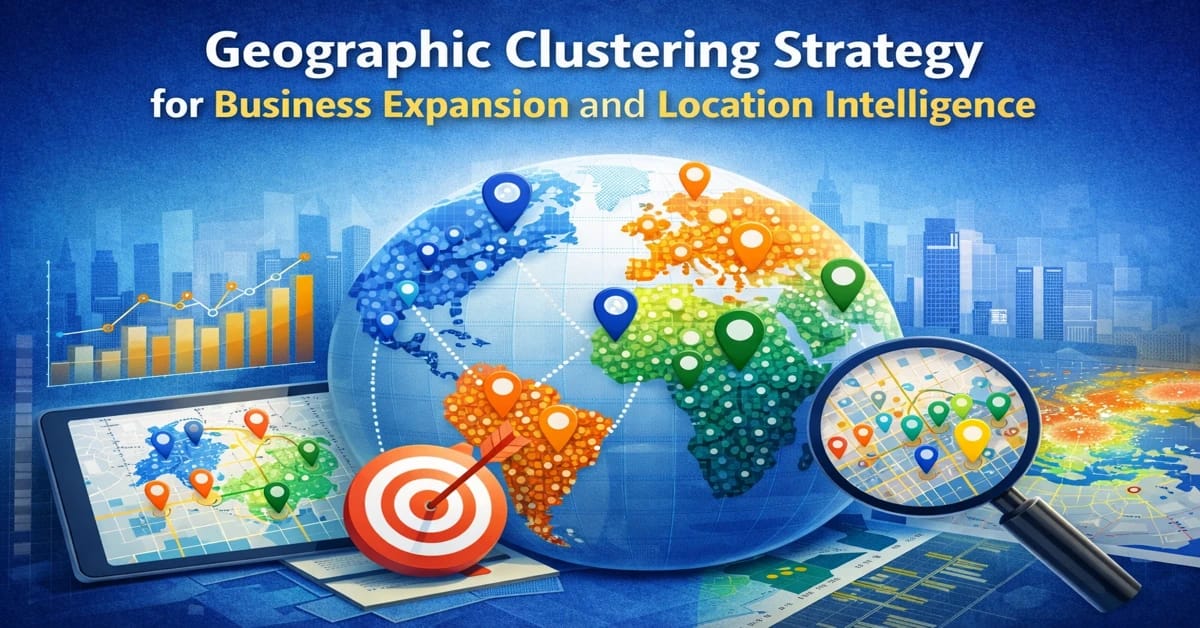
A geographic clustering strategy uses data to group customers, prospects, or business activity based on location. Unlike simple demographic segmentation, this approach considers spatial relationships such as proximity, density, and regional patterns’ o optimize business decisions.
Businesses typically analyze:
-
Customer addresses or geolocation data
-
Purchase behavior in different regions
-
Population density and income levels
-
Traffic patterns and accessibility
By identifying clusters of potential customers or high performing areas, companies can prioritize regions for expansion and target resources efficiently.
Why Geographic Clustering Matters for Expansion
Businesses often make location decisions based on intuition or limited market data. While this may work initially, it can lead to missed opportunities or poor-performing stores. Geographic clustering solves this by providing:
-
Data-driven insights: Visualizes where demand is highest.
-
Reduced risk: Helps avoid costly investments in low-potential areas.
-
Optimized marketing spend: Focuses campaigns on high-density areas.
-
Efficient resource allocation: Guides staffing, inventory, and logistics.
With a strong location intelligence analytics framework, businesses can predict demand, identify underserved areas, and maximize ROI from new locations.
Key Components of Location Intelligence Analytics
Location intelligence analytics combines geographic data with business metrics to provide actionable insights. Key components include:
-
Geospatial data: Maps, coordinates, and spatial relationships.
-
Customer demographics: Age, income, lifestyle, and preferences.
-
Market trends: Competitor locations, regional demand patterns.
-
Business performance metrics: Sales, foot traffic, and operational efficiency.
These elements work together to uncover patterns that traditional analytics might miss. By overlaying performance metrics on geographic data, companies can make smarter territory planning strategy decisions.
Step by Step Guide to Implement a Geographic Clustering Strategy
1. Define Your Objective
Start by clarifying your goal. Are you looking to:
-
Identify optimal locations for new stores?
-
Expand delivery coverage?
-
Improve marketing targeting?
The objective determines the type of data you need and how clusters should be interpreted.
2. Collect and Prepare Data
Gather both geographic and business data:
-
Customer addresses, zip codes, or GPS coordinates
-
Store locations and sales data
-
Competitor locations
-
Demographic and socioeconomic data
Clean and standardize your data. Accurate coordinates and consistent formatting are crucial for meaningful clustering results.
3. Choose the Right Clustering Technique
Several techniques can be applied to geographic data:
-
K-Means Clustering: Groups locations into K clusters based on proximity and density. Best for evenly distributed customer bases.
-
DBSCAN (Density-Based Clustering): Identifies clusters of varying density and isolates outliers. Ideal for irregular patterns or urban/rural differences.
-
Hierarchical Clustering: Useful when you want to understand nested or regional relationships between clusters.
The choice of algorithm depends on your data distribution, business goals, and analytical resources.
4. Analyze Clusters
Once clusters are formed, evaluate:
-
Cluster size and density
-
Average revenue per cluster
-
Distance to competitors or high-traffic areas
-
Accessibility and transportation links
This helps determine which clusters represent high-value opportunities and which are less strategic.
5. Apply Insights to Territory Planning Strategy
Use your cluster analysis to optimize territories and expansion plans:
-
Assign sales teams to regions with high customer density
-
Prioritize locations in underserved clusters for new store openings
-
Adjust marketing campaigns based on cluster behavior
-
Optimize logistics, delivery routes, and supply chain planning
A well-executed territory planning strategy ensures resources are focused where they deliver the most impact.
6. Evaluate Store Location Analysis
Before committing to new locations, conduct a detailed store location analysis within each cluster:
-
Foot traffic and visibility
-
Local competition and saturation
-
Rental or property costs
-
Proximity to complementary businesses
-
Community demographics and purchasing power
This step ensures that your geographic clustering insights translate into actionable, profitable decisions.
Real World Example
A national coffee chain wanted to expand in a new region. Using a geographic clustering strategy, they:
-
Collected customer purchase and loyalty program data.
-
Applied K-means clustering to identify areas with high concentration of potential customers.
-
Conducted store location analysis to select sites with high foot traffic and minimal competition.
-
Adjusted their territory planning strategy for staff allocation and delivery routes.
Result: The chain opened four new stores, each performing above regional benchmarks within six months, proving the value of data-driven expansion planning.
Best Practices for Geographic Clustering
-
Use high quality data: Accuracy is key for meaningful insights.
-
Combine multiple data sources: Integrate demographic, competitor, and performance data for a fuller picture.
-
Visualize your clusters: Maps and heatmaps make patterns easy to interpret and communicate.
-
Update regularly: Customer behavior and market conditions change—review clusters periodically.
-
Align with business goals: Clustering is a tool, not the goal. Ensure insights inform actionable strategies.
Benefits of a Data Driven Geographic Clustering Strategy
Implementing this approach offers measurable benefits:
-
Smarter business expansion decisions
-
Higher ROI on new store openings
-
Improved marketing targeting and efficiency
-
Optimized resource allocation for operations and logistics
-
Competitive advantage through location intelligence analytics
Businesses that adopt geographic clustering strategies gain a clear view of where growth opportunities lie and how to capitalize on them efficiently.
Final Thoughts
A well-executed geographic clustering strategy bridges the gap between raw location data and actionable business decisions. By leveraging location intelligence analytics, businesses can improve territory planning strategy, conduct precise store location analysis, and expand with confidence.
In today’s competitive landscape, intuition alone isn’t enough. Data-driven decisions allow companies to identify opportunities, mitigate risks, and ensure that every new location contributes to sustainable growth.
For businesses looking to scale efficiently, integrating geographic clustering into your expansion planning isn’t just a recommendation—it’s a necessity.
Frequently Asked Questions (FAQs)
1. What is a geographic clustering strategy?
A geographic clustering strategy is a data-driven approach to grouping customers, prospects, or business activity based on location. It helps businesses identify high-density areas, optimize store locations, and make informed expansion decisions.
2. How does location intelligence analytics support business expansion?
Location intelligence analytics combines geographic data with business metrics to provide insights into customer behavior, market trends, and competitor activity. This enables smarter territory planning strategy and ensures new locations are profitable.
3. What is territory planning strategy in geographic clustering?
A territory planning strategy involves allocating resources, sales teams, and operations efficiently based on geographic clusters. It ensures that high-potential areas receive the right focus while minimizing operational costs in less profitable regions.
4. How can I perform store location analysis using geographic clustering?
Store location analysis involves evaluating clusters to determine optimal site placement. Factors include customer density, foot traffic, competitor locations, accessibility, and local demographics. Clustering helps prioritize areas with the highest growth potential.
5. Which industries benefit most from geographic clustering?
Retail chains, restaurants, logistics and delivery services, real estate, banking, and healthcare providers all benefit from geographic clustering strategies. Any business with a physical presence or location-based operations can leverage it for expansion and efficiency.