
Imagine spending weeks creating a website, writing useful articles, uploading products, or building a service page—and then discovering that hardly anyone can find it.
The problem may not be your product, service, or content. Your website may simply not be visible enough in search engines.
This is where SEO, or Search Engine Optimization, becomes important.
Whenever people search for something on Google, Bing, or another search engine, they are presented with a list of results. Businesses, publishers, creators, and organizations all compete for visibility within those results.
SEO is the collection of practices that helps a website become easier for search engines to discover, understand, and potentially rank for relevant searches.
But SEO is much more than adding keywords to a webpage.
Modern SEO connects technical website performance, useful content, search intent, website structure, links, user experience, authority, and many other factors. It has therefore become an important part of the wider digital marketing ecosystem.
Whether you are building a personal brand, running an e-commerce store, managing a company website, working in digital marketing, publishing content, or developing an online business, understanding SEO can help you make better decisions about how people discover your website.
What Is SEO?
SEO stands for Search Engine Optimization.
In simple terms, SEO is the process of improving a website and its content so that search engines can better understand it and users can discover it when searching for relevant information, products, services, or solutions.
For example, suppose you run a website that sells fitness equipment.
Someone searches:
“best home workout equipment”
There may be thousands of webpages that could potentially answer that search.
A search engine has to determine which pages are relevant, useful, trustworthy, accessible, and appropriate for the searcher’s needs.
SEO helps your website communicate its value and relevance more effectively.
A simple way to understand it is:
SEO helps search engines understand your website and helps the right people discover it.
Why Is SEO Important in Digital Marketing?
Digital marketing includes many channels, such as social media marketing, email marketing, paid advertising, content marketing, influencer marketing, affiliate marketing, and search marketing.
SEO is particularly important because it can help businesses reach people at the moment they are actively searching for something.
Consider the difference between these two situations.
A person sees an advertisement for a pair of headphones while scrolling through social media.
Another person searches:
“best wireless headphones under ₹3000”
The second person has already expressed a specific interest.
If your website sells headphones and appears for that search, you are reaching a user who is actively looking for information related to your product.
This is one of the biggest advantages of search visibility.
SEO Can Generate Organic Traffic
Organic traffic refers to visitors who reach your website through unpaid search results.
Unlike paid advertising, you do not pay the search engine for every organic click.
However, that does not mean SEO is free.
SEO requires investment in areas such as:
- Content creation
- Website development
- Research
- SEO tools
- Technical optimization
- Digital PR
- Link building
- Expertise and time
The difference is that SEO aims to build long-term organic visibility rather than purchasing every individual visit.
SEO Can Improve Brand Visibility
Ranking for relevant searches can put your brand in front of potential customers before they know much about your business.
For example, someone searching for information about digital marketing may repeatedly encounter the same website in useful search results.
Over time, those appearances can contribute to brand recognition and familiarity.
SEO Can Support Business Growth
For many businesses, search traffic can contribute to:
- Website visits
- Leads
- Product sales
- Service inquiries
- Newsletter subscriptions
- App downloads
- Brand discovery
The important point is that SEO should not be measured only by rankings or traffic.
A page receiving 10,000 visitors who have no interest in your product may be less valuable than a page receiving 500 highly relevant visitors who convert into customers.
How Do Search Engines Work?
To understand SEO, it helps to understand what search engines are trying to do.
Their fundamental goal is to provide users with useful results for their searches.
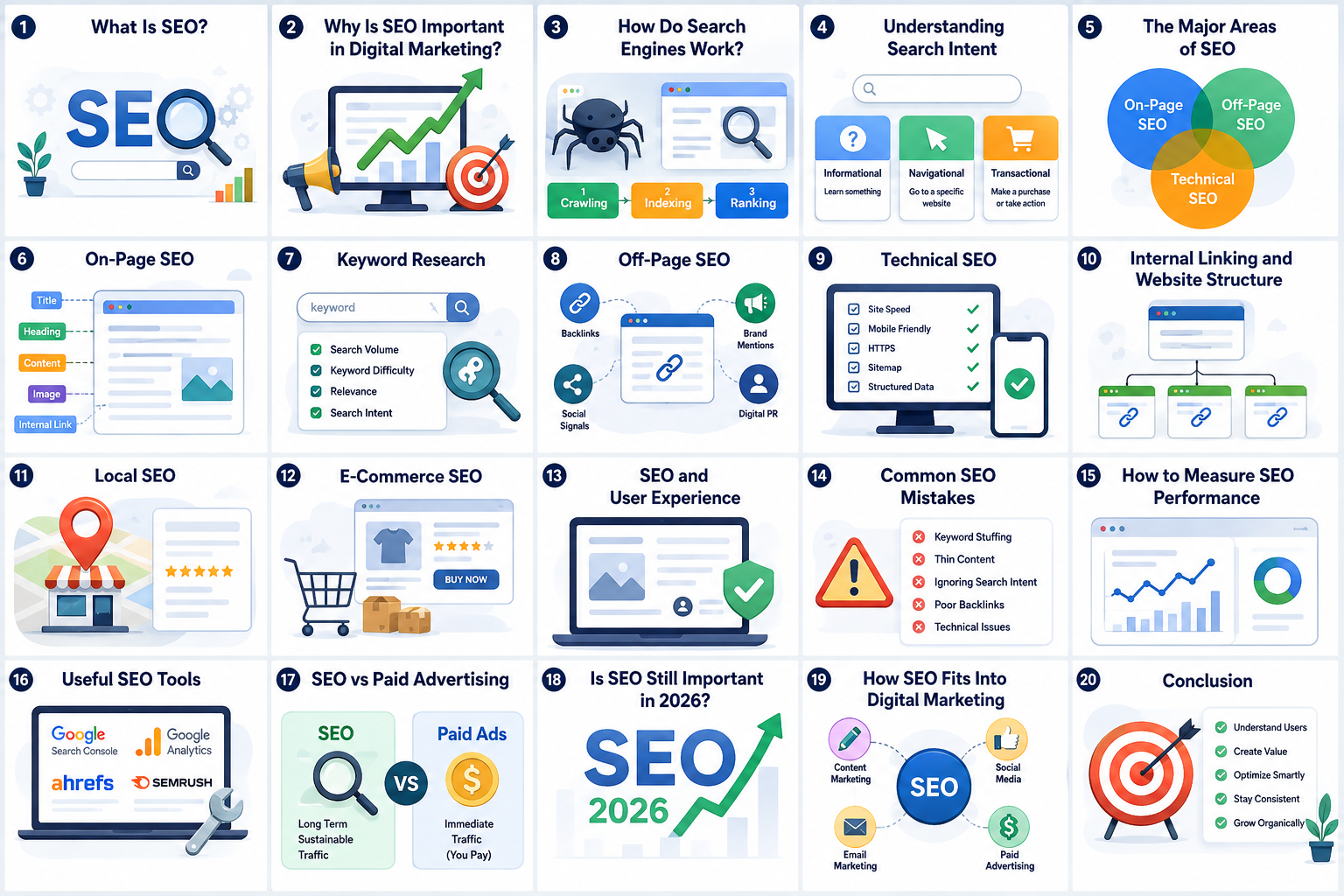
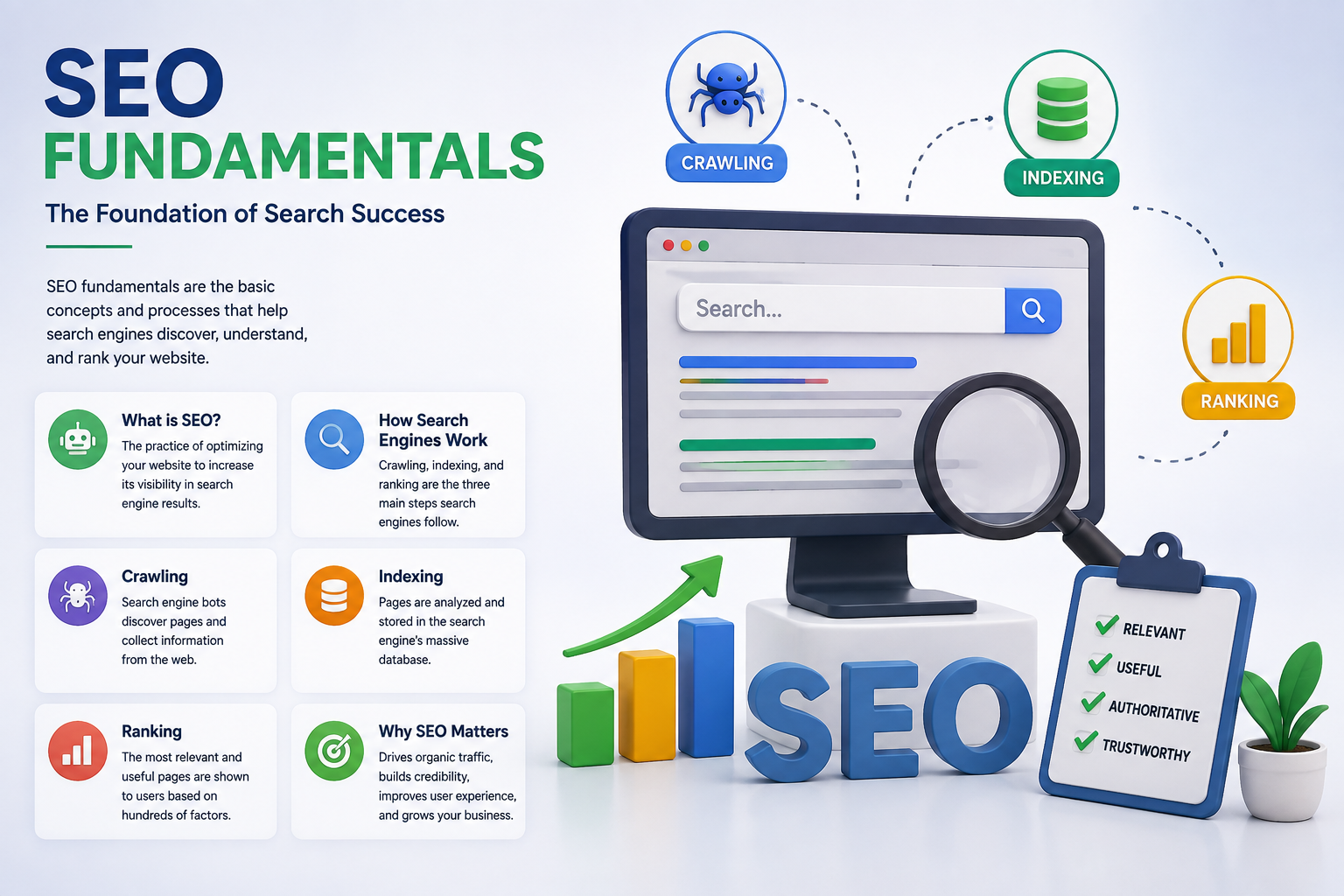
Although modern search engines are extremely sophisticated, their processes can be simplified into three concepts:
Crawling
Search engines use automated systems to discover webpages across the internet.
These systems can follow links and discover new or updated content.
Indexing
After discovering a webpage, a search engine may analyze and store information about it in its index.
It attempts to understand what the page is about, what information it contains, and how it relates to other content.
Ranking
When a person performs a search, the search engine evaluates available information and determines which results are most appropriate for that particular query.
This is where SEO becomes relevant.
The goal is not to “trick” a search engine into ranking a page.
The goal is to create a website and content that genuinely deserve visibility for relevant searches.
Understanding Search Intent
One of the most important concepts in modern SEO is search intent.
Search intent means the reason behind a user’s search.
Consider these three searches:
“What is SEO?”
The user is probably looking for an explanation.
“Best SEO tools”
The user may be comparing different tools.
“Semrush pricing”
The user is likely looking for pricing information about a specific product.
These searches may all relate to SEO, but the intent is different.
If you understand the intent behind a search, you can create content that better satisfies what the user actually wants.
This is why simply selecting a keyword and repeating it throughout an article is not a strong SEO strategy.
The Major Areas of SEO
SEO is a broad field, but it can be understood through several major areas.
The three commonly discussed categories are:
- On-page SEO
- Off-page SEO
- Technical SEO
Other areas, such as local SEO, e-commerce SEO, image SEO, and international SEO, can also become important depending on the website.
On-Page SEO
On-page SEO focuses on elements that exist on your website and individual webpages.
This includes:
- Page titles
- Headings
- Content
- Keywords and related terminology
- Search intent
- Internal links
- Images
- Image alt text
- URLs
- Content structure
- User experience
For example, if you publish an article about “email marketing strategies,” the page should clearly explain those strategies and organize the information logically.
A good webpage should make sense to both users and search engines.
Content Quality Matters
One of the biggest changes in SEO over the years has been the growing importance of useful content.
Simply producing an article containing a target keyword is not enough.
A strong piece of content should:
- Answer the user’s question
- Provide accurate information
- Cover the topic appropriately
- Be easy to understand
- Offer useful examples
- Add something valuable
- Be maintained when information changes
The goal should be to create the best possible resource for the intended audience—not simply the longest article.
Keyword Research
Keywords are words and phrases people use when searching.
For example, a digital marketing website might research terms such as:
- SEO
- search engine optimization
- SEO strategy
- on-page SEO
- technical SEO
- link building
- SEO tools
- local SEO
Keyword research helps marketers understand what their audience is looking for.
However, modern keyword research is not simply about finding keywords with the highest search volume.
You should also consider:
- Search intent
- Relevance
- Competition
- Business value
- Search result types
- Content requirements
- Your website’s ability to compete
A keyword with 100,000 monthly searches is not automatically better than one with 1,000 searches.
If the smaller keyword attracts people who are much more likely to become customers, it could be more valuable.
Off-Page SEO
Off-page SEO focuses on activities outside your website that can influence its visibility, reputation, and authority.
One of the most recognized parts of off-page SEO is link building.
A backlink is a link from another website to your website.
For example, suppose you publish an original study about digital marketing trends.
A respected marketing publication references your research in its own article and links to your study.
That is a backlink.
Quality Matters More Than Quantity
A common misconception is that the website with the largest number of backlinks will automatically rank higher.
SEO does not work that simply.
A relevant, trustworthy backlink can be more meaningful than hundreds of irrelevant or low-quality links.
Effective off-page SEO can involve:
- Digital PR
- Content promotion
- Relationship building
- Relevant guest contributions
- Industry partnerships
- Brand mentions
- Earning editorial links
The objective should be to build genuine authority and visibility rather than manipulate search rankings.
Technical SEO
Technical SEO focuses on the technical foundation of a website.
Important areas can include:
- Website speed
- Mobile usability
- HTTPS
- Site architecture
- XML sitemaps
- Robots.txt
- Canonical URLs
- Structured data
- Crawlability
- Indexing
- Core Web Vitals
Imagine creating an excellent article, but search engines cannot properly access or index the page.
The quality of the writing will not solve that technical problem.
Technical SEO therefore provides the foundation that allows your content and website structure to work effectively.
Internal Linking and Website Structure
Internal links connect pages within the same website.
For example, an SEO article might link to separate resources about:
- Keyword research
- Backlinking
- Technical SEO
- Content marketing
- Local SEO
Internal linking can help users discover related information and can help search engines understand the relationships between pages.
For websites with large amounts of content, a well-planned internal linking structure can be particularly valuable.
It can also help create topic clusters, where several supporting pages connect to a broader central topic.
Local SEO
Not every search is global.
Many searches have a strong local intent.
Examples include:
- “restaurant near me”
- “SEO agency in Delhi”
- “dentist in Mumbai”
- “best gym in Ghaziabad”
Local SEO focuses on helping businesses become more visible for searches connected to a particular location.
Important local SEO activities can include maintaining accurate business information, developing relevant local content, managing business profiles, earning legitimate local mentions, and building a strong online reputation.
For businesses that depend on local customers, local search visibility can be extremely important.
E-Commerce SEO
Online stores have their own SEO challenges.
An e-commerce SEO strategy may involve optimizing:
- Product pages
- Category pages
- Product descriptions
- Images
- Internal links
- Structured data
- Site navigation
- Filters
- Reviews
- Technical performance
For example, an online electronics store should make it easy for both users and search engines to understand its product categories and individual products.
A well-optimized product page should provide useful information rather than simply repeating the product name.
SEO and User Experience
SEO and user experience are closely connected.
Imagine a page that ranks well but:
- Takes 10 seconds to load
- Is difficult to navigate
- Contains huge blocks of text
- Has intrusive elements
- Does not answer the user’s question
Even if people arrive through search, they may leave quickly.
Good SEO therefore should not stop at getting someone to click.
The experience after the click matters too.
The best SEO strategy connects:
Search visibility → Useful content → Good experience → Desired action
Common SEO Mistakes
SEO has changed significantly, but several mistakes remain common.
Keyword Stuffing
Repeating a keyword unnaturally throughout a page can make the content difficult to read.
Use keywords where they make sense and focus on covering the topic naturally.
Creating Content Only for Search Engines
Publishing hundreds of low-value pages will not automatically create a successful website.
Content should have a clear purpose and provide genuine value.
Ignoring Search Intent
A page may target the correct keyword but still fail to satisfy users if it provides the wrong type of content.
Always examine the search results and understand what people are actually looking for.
Buying Manipulative Backlinks
Links obtained solely to manipulate search rankings can create SEO risks.
Focus on earning legitimate mentions and links through useful resources, relationships, digital PR, and high-quality content.
Ignoring Technical Problems
A website with broken pages, indexing problems, poor mobile usability, or serious performance issues can struggle even if its content is excellent.
Expecting Immediate Results
SEO is usually a long-term process.
Competition, website history, content quality, technical performance, industry conditions, and many other factors can affect how quickly results appear.
Anyone promising guaranteed #1 rankings should be treated cautiously.
How to Measure SEO Performance
SEO should be measured according to business objectives.
Useful metrics can include:
- Organic traffic
- Search impressions
- Click-through rate
- Keyword visibility
- Conversions
- Leads
- Sales
- Revenue
- Indexed pages
- Referring domains
- Engagement
- Brand visibility
For example, an e-commerce business may care more about organic revenue than total organic traffic.
A publisher may prioritize traffic, newsletter subscriptions, and returning readers.
This is why SEO reporting should connect search performance with actual business outcomes.
Useful SEO Tools
You do not need dozens of tools to start working with SEO.
Some widely used resources include:
Google Search Console
Useful for understanding how your website performs in Google Search and identifying information about search visibility and indexing.
Google Analytics
Useful for understanding website traffic and user behavior.
Google Trends
Useful for exploring changes in search interest and comparing topics.
SEO Platforms
Professional platforms such as Ahrefs, Semrush, Moz, and others can provide capabilities for keyword research, competitor analysis, backlink research, site audits, and content research.
The important thing is not how many tools you use.
It is whether you can turn the information from those tools into better decisions.
SEO vs Paid Advertising
SEO and paid advertising are often compared, but they serve different purposes.
Paid advertising can provide immediate visibility when you are willing to pay for placements or clicks.
SEO generally takes longer to build but can create sustained organic visibility.
For many businesses, the best approach is not choosing one over the other.
Instead, they can work together.
For example:
Paid advertising → Immediate traffic and testing
SEO → Long-term organic visibility
Data from paid campaigns can sometimes also provide useful insights into messaging, keywords, and audience behavior that can inform broader marketing decisions.
Is SEO Still Important in 2026?
Yes, but the way SEO is approached continues to evolve.
Search engines are becoming increasingly sophisticated at understanding language, context, topics, entities, and user needs.
At the same time, artificial intelligence has made it easier to produce content at scale.
This creates an important distinction:
Creating content is becoming easier. Creating content that people genuinely value is still difficult.
Businesses and marketers should therefore focus on:
- Original insights
- First-hand experience
- Accurate information
- Useful examples
- Strong topical coverage
- Clear communication
- Technical quality
- Good user experience
- Genuine authority
- Relevant reputation
AI can be useful for research, brainstorming, organization, and many other parts of a marketing workflow.
But simply publishing large amounts of generic AI-generated content is not a sustainable SEO strategy.
How SEO Fits Into Digital Marketing
SEO should not operate in isolation.
It can work alongside almost every major digital marketing channel.
SEO + Content Marketing
Content provides the information that search engines and users can discover.
SEO + Social Media
Social platforms can help distribute content and increase brand awareness, even though social visibility and search rankings are not the same thing.
SEO + Email Marketing
Search traffic can introduce new people to a brand, while email can help businesses build ongoing relationships with those visitors.
SEO + Affiliate Marketing
Affiliate websites can use SEO to attract users searching for product information, comparisons, reviews, and recommendations.
SEO + Digital PR
Digital PR can generate brand exposure, mentions, and potentially valuable links.
This is why SEO is better understood as part of a broader digital marketing strategy rather than a completely separate activity.
Frequently Asked Questions About SEO
What does SEO stand for?
SEO stands for Search Engine Optimization. It refers to the process of improving websites and their content so that search engines can better discover, understand, and potentially rank them for relevant searches.
Is SEO free?
Organic search results do not require businesses to pay for every click, but SEO still requires investment in time, expertise, content, technology, tools, and website improvements.
How long does SEO take?
There is no fixed timeline. Results can vary depending on competition, website authority, content quality, technical performance, search intent, and many other factors.
Is SEO better than paid advertising?
Neither is universally better. Paid advertising can provide faster visibility, while SEO can build long-term organic visibility. Many businesses use both.
Can SEO guarantee a first-page ranking?
No legitimate SEO professional can guarantee a specific Google ranking.
Search results are competitive and can change over time.
Is keyword density important for SEO?
There is no universal ideal keyword density.
Keywords should be used naturally while the content focuses on satisfying the user’s needs and covering the topic appropriately.
Are backlinks still important for SEO?
Backlinks remain an important part of SEO, but quality and relevance matter. SEO success depends on many factors rather than backlinks alone.
Conclusion
SEO, or Search Engine Optimization, is an essential part of modern digital marketing because it helps businesses, creators, publishers, and organizations become more discoverable when people search for relevant information, products, services, and solutions.
But SEO is not simply about reaching the first position on Google.
At its core, effective SEO is about understanding what people need and creating a website that can deliver that value efficiently.
That means understanding search intent, researching topics and keywords, creating useful content, maintaining a technically sound website, building sensible internal links, earning relevant backlinks, improving user experience, and measuring the results.
The strongest SEO strategies also recognize that search is only one part of the customer journey.
A person may discover your website through Google, follow your brand on social media, read your content, subscribe to your email list, and eventually become a customer.
That is why SEO works best when it is connected to the broader digital marketing strategy.
Whether you are managing a business website, building an online store, publishing content, working in marketing, or developing a personal brand, SEO is a skill and discipline worth understanding.
Search behavior will continue to change. Technology will continue to evolve. Search engines will continue to become more sophisticated.
But one principle is unlikely to change:
Create something genuinely useful for people, make it accessible and understandable, and give search engines a clear reason to discover it.
That is the foundation of sustainable SEO.




great work your content are useful and informative.👍🙌🙌🙌