The biggest difference comes down to intent vs interruption.meta ads vs google ads which lead generation meta ads
| Factor | Google Ads | Meta Ads |
|---|---|---|
| How it works | Shows ads to people actively searching | Shows ads to people based on interests/behavior |
| Buyer intent | High — user is looking for a solution | Low to medium — user isn’t actively searching |
| Best for | Services people search for (plumbers, lawyers, SaaS, ecommerce) | Brand awareness, impulse-driven products, visual offers |
| Ad format | Text-based search ads, Shopping ads | Image, video, carousel, Reels |
| Cost model | Often higher CPC, but higher intent | Often lower CPC, but needs nurturing |
| Lead quality | Generally higher intent, ready to convert | Mixed — needs qualification/follow-up |
Google Ads for Lead Generation
Google Ads works on search intent. When someone types “best CRM software for small business” or “emergency plumber near me,” they already know what they want — they just need to find the right provider.
Meta Ads for Lead Generation
Meta Ads (Facebook and Instagram) work on interruption-based marketing. You’re not waiting for someone to search — you’re putting your offer in front of the right audience while they scroll.
Strengths
- Powerful targeting — interests, behaviors, lookalike audiences, custom audiences (past customers, website visitors)
- Great for visual and emotional storytelling through video, Reels, and carousel ads
- Usually lower cost per click, especially for cold traffic
- Excellent for retargeting website visitors and warm leads
- Built-in Lead Ads let users submit their info without leaving the app
Weaknesses
- Lower intent — you’re often creating the need, not fulfilling an existing one
- Requires strong creative (image/video) to stop the scroll
- Leads may need more nurturing before they convert into customers
Best for
Businesses with a visual product, a broad target audience, or a need to build brand awareness: ecommerce, coaching/courses, real estate showcases, fitness, beauty, and local service businesses that benefit from storytelling.
Cost Comparison: Which Platform Is Cheaper?
There’s no universal number here — costs vary heavily by industry — but here’s the general pattern:
- Google Ads CPC tends to be higher because you’re paying for intent. Competitive industries like legal or insurance can see CPCs of $20–$100+.
- Meta Ads CPC is often lower, but you may need more clicks/impressions to get a qualified lead since intent is lower.
Rule of thumb: Google Ads often gives you a higher cost-per-click but a lower cost-per-qualified-lead. Meta Ads often gives you a lower cost-per-click but a higher volume of unqualified leads that need filtering.
Lead Quality: Which Platform Generates Better Leads?
This is where most businesses actually lose money — not from bad ad spend, but from poor lead quality assumptions.
- Google Ads leads are typically further along in the buying journey. They searched for a solution, so they’re more likely to be ready to talk to sales.
- Meta Ads leads are typically earlier in the journey. They may be interested but not ready to buy — which means your follow-up process matters more.
If your sales team can’t follow up quickly with Meta leads, conversion rates will suffer — not because the platform failed, but because the lead wasn’t nurtured.
Which One Should You Choose?
Here’s a simple framework:
Choose Google Ads if:
- People actively search for what you offer
- You sell a service people need urgently (repairs, legal help, medical)
- You have a higher budget and want higher-intent leads
- You operate in a local service area
Choose Meta Ads if:
- Your product/service is visual or benefits from storytelling
- You want to build brand awareness alongside lead generation
- You want to retarget website visitors or past customers
- You’re working with a smaller budget and want more volume to test messaging
Use both if:
- You want a full-funnel strategy — Meta Ads to build awareness and warm up cold audiences, Google Ads to capture the high-intent searches that follow.
This combined approach is often what performs best for businesses that can afford to run both: Meta creates demand, Google captures it.
Final Thoughts
There’s no single winner in the Meta Ads vs Google Ads debate — the “better” platform depends entirely on your industry, your budget, and your sales process.
If your customers actively search for solutions, start with Google Ads. If your product benefits from visual storytelling and broader targeting, start with Meta Ads. And if you have the budget to run both, you’ll likely get the best results by using them together — one to create demand, the other to capture it.
FAQs
Is Meta Ads cheaper than Google Ads? Generally, yes — Meta Ads tends to have lower CPCs, but Google Ads often delivers higher-intent leads, so cost-per-qualified-lead can even out.
Which platform is better for B2B lead generation? Google Ads often performs better for B2B because decision-makers actively search for solutions, but LinkedIn and Meta can work well for awareness and retargeting.
Can I run Meta Ads and Google Ads at the same time? Yes, and many businesses see the best ROI by doing so — using Meta for top-of-funnel awareness and Google for bottom-of-funnel conversions.
What’s the Core Difference Between Meta Ads and Google Ads?
The biggest difference comes down to intent vs interruption.
| Factor | Google Ads | Meta Ads |
|---|---|---|
| How it works | Shows ads to people actively searching | Shows ads to people based on interests/behavior |
| Buyer intent | High — user is looking for a solution | Low to medium — user isn’t actively searching |
| Best for | Services people search for (plumbers, lawyers, SaaS, ecommerce) | Brand awareness, impulse-driven products, visual offers |
| Ad format | Text-based search ads, Shopping ads | Image, video, carousel, Reels |
| Cost model | Often higher CPC, but higher intent | Often lower CPC, but needs nurturing |
| Lead quality | Generally higher intent, ready to convert | Mixed — needs qualification/follow-up |
Google Ads for Lead Generation
Google Ads works on search intent. When someone types “best CRM software for small business” or “emergency plumber near me,” they already know what they want — they just need to find the right provider.
Strengths
- High-intent traffic — people are already looking for a solution
- Great for local businesses (via Local Service Ads and Search)
- Works well for high-ticket B2B and service-based businesses
- Leads tend to convert faster since there’s less “convincing” involved
Weaknesses
- Can be expensive per click, especially in competitive industries (legal, insurance, finance)
- Limited targeting beyond keywords, location, and demographics
- Doesn’t work well if your product/service is new and people don’t know to search for it yet
Best for
Businesses where the customer already knows they have a problem: home services, healthcare, legal, B2B software, real estate, and local businesses.
Meta Ads for Lead Generation
Meta Ads (Facebook and Instagram) work on interruption-based marketing. You’re not waiting for someone to search — you’re putting your offer in front of the right audience while they scroll.
Strengths
- Powerful targeting — interests, behaviors, lookalike audiences, custom audiences (past customers, website visitors)
- Great for visual and emotional storytelling through video, Reels, and carousel ads
- Usually lower cost per click, especially for cold traffic
- Excellent for retargeting website visitors and warm leads
- Built-in Lead Ads let users submit their info without leaving the applead generation meta ads
Weaknesses
- Lower intent — you’re often creating the need, not fulfilling an existing one
- Requires strong creative (image/video) to stop the scroll
- Leads may need more nurturing before they convert into customers
Best for
Businesses with a visual product, a broad target audience, or a need to build brand awareness: ecommerce, coaching/courses, real estate showcases, fitness, beauty, and local service businesses that benefit from storytelling.
Cost Comparison: Which Platform Is Cheaper?
There’s no universal number here — costs vary heavily by industry — but here’s the general pattern: lead generation meta ads
- Google Ads CPC tends to be higher because you’re paying for intent. Competitive industries like legal or insurance can see CPCs of $20–$100+.
- Meta Ads CPC is often lower, but you may need more clicks/impressions to get a qualified lead since intent is lower.
Rule of thumb: Google Ads often gives you a higher cost-per-click but a lower cost-per-qualified-lead. Meta Ads often gives you a lower cost-per-click but a higher volume of unqualified leads that need filtering.
Lead Quality: Which Platform Generates Better Leads?
This is where most businesses actually lose money — not from bad ad spend, but from poor lead quality assumptions.
- Google Ads leads are typically further along in the buying journey. They searched for a solution, so they’re more likely to be ready to talk to sales.
- Meta Ads leads are typically earlier in the journey. They may be interested but not ready to buy — which means your follow-up process matters more.
If your sales team can’t follow up quickly with Meta leads, conversion rates will suffer — not because the platform failed, but because the lead wasn’t nurtured.
Which One Should You Choose?
Here’s a simple framework:
Choose Google Ads if:
- People actively search for what you offer
- You sell a service people need urgently (repairs, legal help, medical)
- You have a higher budget and want higher-intent leads
- You operate in a local service area
Choose Meta Ads if:
- Your product/service is visual or benefits from storytelling
- You want to build brand awareness alongside lead generation
- You want to retarget website visitors or past customers
- You’re working with a smaller budget and want more volume to test messaging
Use both if:
- You want a full-funnel strategy — Meta Ads to build awareness and warm up cold audiences, Google Ads to capture the high-intent searches that follow.
This combined approach is often what performs best for businesses that can afford to run both: Meta creates demand, Google captures it.
Final Thoughts
There’s no single winner in the Meta Ads vs Google Ads debate — the “better” platform depends entirely on your industry, your budget, and your sales process.
If your customers actively search for solutions, start with Google Ads. If your product benefits from visual storytelling and broader targeting, start with Meta Ads. And if you have the budget to run both, you’ll likely get the best results by using them together — one to create demand, the other to capture it.
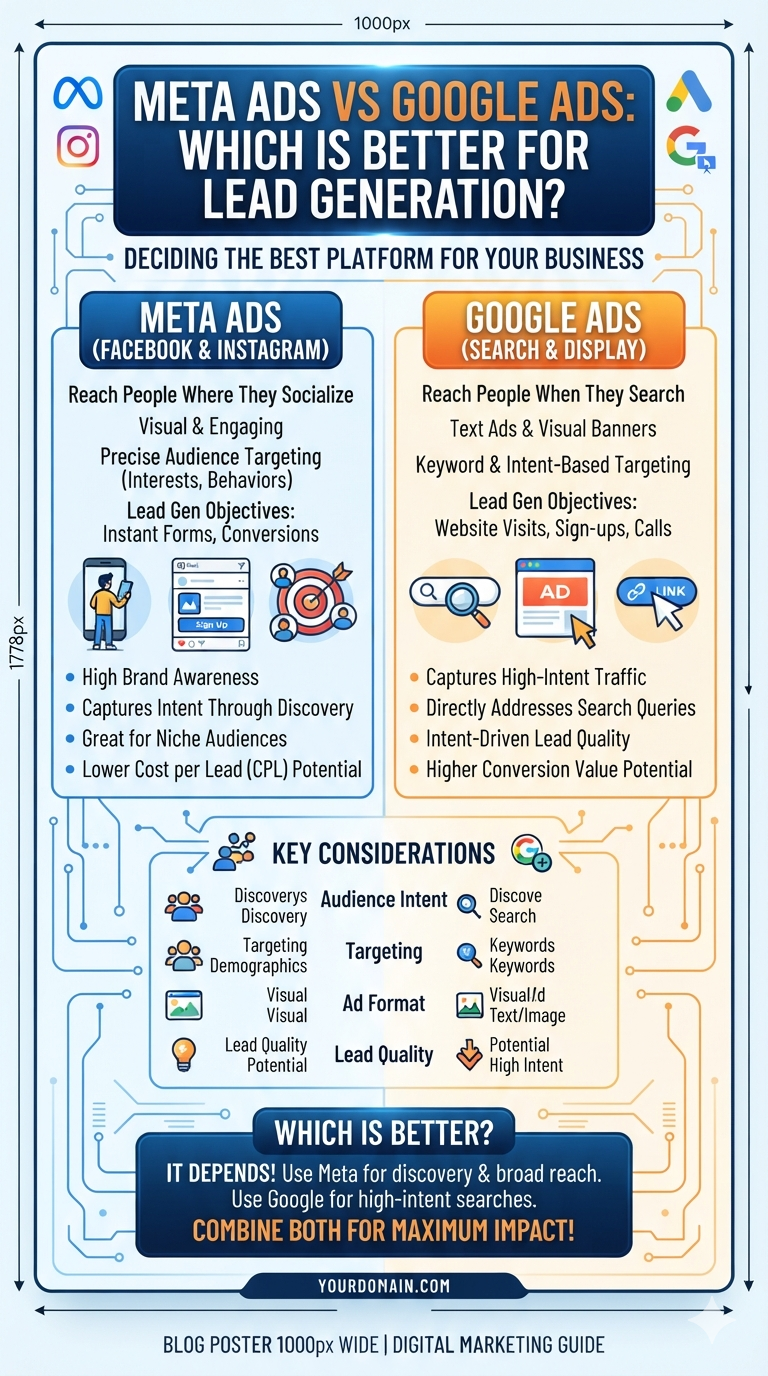
Meta Ads vs Google Ads: Which Is Better for Lead Generation?
Meta description: Meta Ads vs Google Ads for lead generation — compare cost, intent, targeting, and funnel fit to choose the right platform (or the right mix) for your business.
If you’re trying to generate leads for your business, chances are you’ve already asked yourself this question: should I run Meta Ads or Google Ads?
Both platforms can generate leads. Both can also waste your budget if used the wrong way. The real answer isn’t “one is better than the other” — it’s about understanding how each platform works, what kind of leads it brings, and which one fits your business model.
In this guide, we’ll break down Meta Ads vs Google Ads for lead generation so you can make a confident, data-backed decision.
Quick Answer
- Google Ads is better when people are actively searching for your product or service (high intent).
- Meta Ads is better when you need to create demand, build awareness, or target based on interests, behavior, and demographics (low-to-medium intent).
- The best results usually come from using both together, at different stages of the funnel.
What’s the Core Difference Between Meta Ads and Google Ads?
The biggest difference comes down to intent vs interruption. meta ads vs google ads which
| Factor | Google Ads | Meta Ads |
|---|---|---|
| How it works | Shows ads to people actively searching | Shows ads to people based on interests/behavior |
| Buyer intent | High — user is looking for a solution | Low to medium — user isn’t actively searching |
| Best for | Services people search for (plumbers, lawyers, SaaS, ecommerce) | Brand awareness, impulse-driven products, visual offers |
| Ad format | Text-based search ads, Shopping ads | Image, video, carousel, Reels |
| Cost model | Often higher CPC, but higher intent | Often lower CPC, but needs nurturing |
| Lead quality | Generally higher intent, ready to convert | Mixed — needs qualification/follow-up |
Google Ads for Lead Generation
Google Ads works on search intent. When someone types “best CRM software for small business” or “emergency plumber near me,” they already know what they want — they just need to find the right provider.
Strengths
- High-intent traffic — people are already looking for a solution
- Great for local businesses (via Local Service Ads and Search)
- Works well for high-ticket B2B and service-based businesses
- Leads tend to convert faster since there’s less “convincing” involved
Weaknesses
- Can be expensive per click, especially in competitive industries (legal, insurance, finance)
- Limited targeting beyond keywords, location, and demographics
- Doesn’t work well if your product/service is new and people don’t know to search for it yet
Meta Ads for Lead Generation
Meta Ads (Facebook and Instagram) work on interruption-based marketing. You’re not waiting for someone to search — you’re putting your offer in front of the right audience while they scroll.
Strengths
- Powerful targeting — interests, behaviors, lookalike audiences, custom audiences (past customers, website visitors)
- Great for visual and emotional storytelling through video, Reels, and carousel ads
- Usually lower cost per click, especially for cold traffic
Weaknesses
- Lower intent — you’re often creating the need, not fulfilling an existing one
- Requires strong creative (image/video) to stop the scroll
- Leads may need more nurturing before they convert into customers
Best for
Businesses with a visual product, a broad target audience, or a need to build brand awareness: ecommerce, coaching/courses, real estate showcases, fitness, beauty, and local service businesses that benefit from storytelling.
Cost Comparison: Which Platform Is Cheaper?
There’s no universal number here — costs vary heavily by industry — but here’s the general pattern:
- Google Ads CPC tends to be higher because you’re paying for intent. Competitive industries like legal or insurance can see CPCs of $20–$100+.
- Meta Ads CPC is often lower, but you may need more clicks/impressions to get a qualified lead since intent is lower.
Final Thoughts
There’s no single winner in the Meta Ads vs Google Ads debate — the “better” platform depends entirely on your industry, your budget, and your sales process.
If your customers actively search for solutions, start with Google Ads. If your product benefits from visual storytelling and broader targeting, start with Meta Ads. And if you have the budget to run both, you’ll likely get the best
FAQs
Is Meta Ads cheaper than Google Ads? Generally, yes — Meta Ads tends to have lower CPCs, but Google Ads often delivers higher-intent leads, so cost-per-qualified-lead can even out.Which platform is better for B2B lead generation? Google Ads often performs better for B2B because decision-makers actively search
which is beeter for lead generation meta ads vs google