
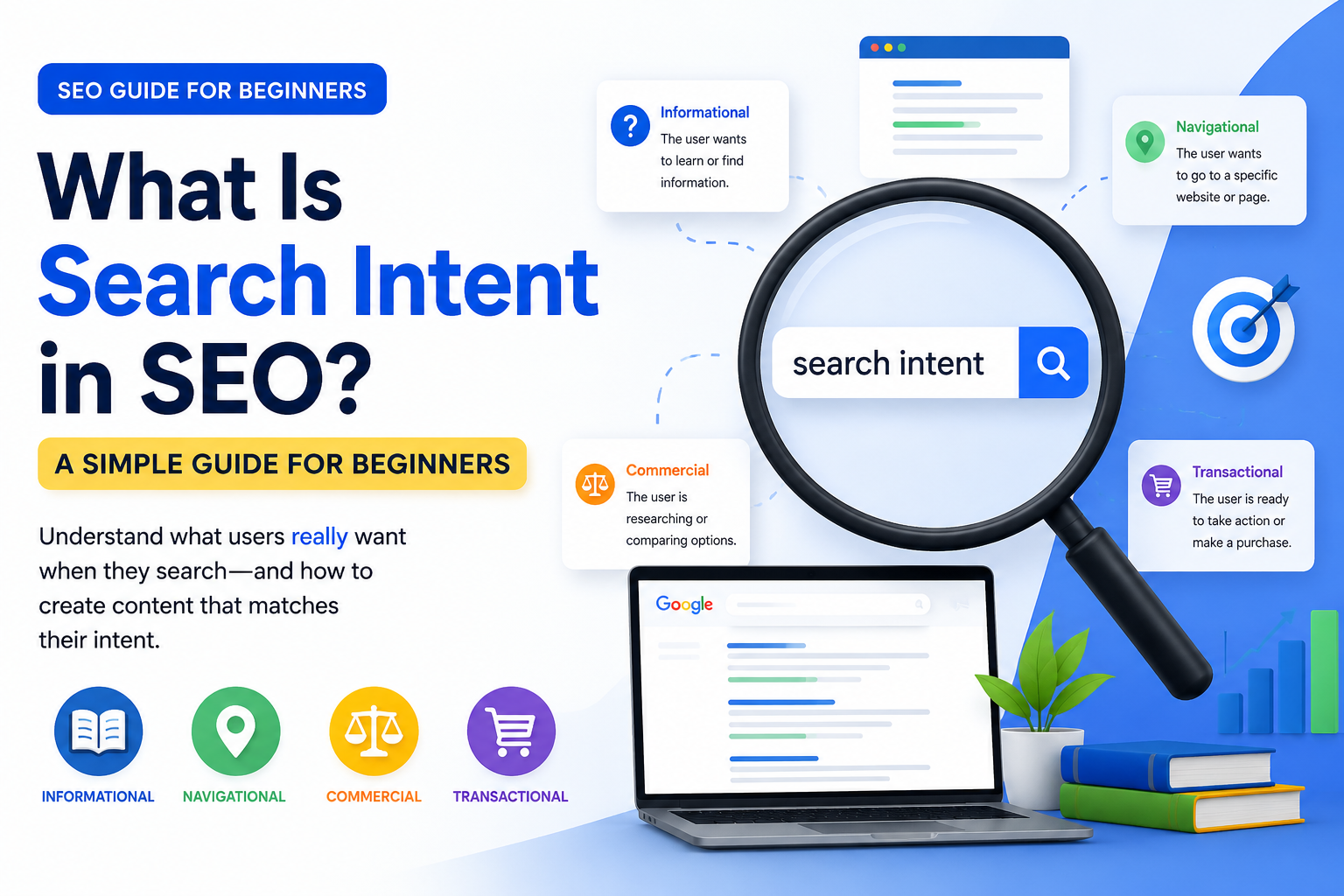
If you want your website to rank on Google, choosing the right keyword is only half the job. The other half is understanding what the person searching that keyword actually wants.
That hidden goal is called search intent.
For example, someone searching “what is SEO?” wants to learn. Someone searching “best SEO tools for beginners” is comparing options. And someone searching “buy SEO course” is ready to take action.
These searches may all relate to SEO, but the user behind each query wants something different.
That is why understanding search intent in SEO is so important. Your content needs to match the searcher’s goal—not simply contain the keyword.
In this beginner-friendly guide, you’ll learn what search intent means, the four main types, real examples, how to identify intent, and how to use it when creating SEO content.
What Is Search Intent in SEO?
Search intent is the reason or goal behind a user’s search query.
In simple words, search intent answers one question:
“What does this person want to find, learn, compare, or do?”
For example:
| Search Query | What the User Wants | Search Intent |
|---|---|---|
| What is digital marketing? | Learn about digital marketing | Informational |
| Amazon login | Visit Amazon | Navigational |
| Best digital marketing courses | Compare courses | Commercial |
| Buy a digital marketing course | Purchase a course | Transactional |
Search engines try to understand the meaning behind queries and return results that are relevant to what the searcher is trying to accomplish. Google also emphasizes creating useful, people-first content rather than content created mainly to attract search traffic.
So, in SEO, your goal should not simply be:
“How can I put my keyword on the page?”
A better question is:
“What would satisfy the person who searched this keyword?”
That is the foundation of search intent.
Why Is Search Intent Important for SEO?
Imagine you search for:
“best laptops for students”
You probably expect a comparison or list of recommended laptops.
Now imagine Google shows you a page titled:
“What Is a Laptop? Complete Beginner’s Guide”
The page might be well-written. It might even mention laptops hundreds of times.
But it doesn’t satisfy what you wanted.
This is an intent mismatch.
Search intent helps you choose the right:
- Content topic
- Page type
- Content format
- Headings
- Examples
- Call to action
- Internal links
- Level of detail
Google’s current guidance encourages creators to make content that is helpful, reliable, unique, and satisfying for people.
That means SEO isn’t just about matching words. It is about matching needs.
The 4 Main Types of Search Intent
SEO professionals commonly organize search intent into four broad categories:
- Informational
- Navigational
- Commercial investigation
- Transactional
These categories are useful for planning content, although some searches can have more than one intent. For example, a search such as “best smartphones under ₹30,000” can involve both research and purchase consideration.
Let’s understand each one.
1. Informational Search Intent
Informational intent means the user wants to learn something or get an answer.
The person isn’t necessarily trying to buy anything. They simply want information.
Examples of informational searches
- What is SEO?
- What is search intent in SEO?
- How does Google Search work?
- How to do keyword research
- Why is SEO important?
- What is a meta description?
Words such as what, why, how, guide, tutorial, meaning, definition, and examples can often indicate informational intent.
What type of content works best?
For informational searches, you will usually create:
- Blog posts
- Beginner guides
- Tutorials
- How-to articles
- Educational resources
- Glossaries
- FAQs
For example, if someone searches:
“What is on-page SEO?”
A detailed beginner guide is usually more appropriate than a sales page for an SEO service.
Beginner tip
When the searcher’s main question is “I want to understand this,” you’re probably dealing with informational intent.
2. Navigational Search Intent
Navigational intent means the user wants to reach a particular website, brand, page, or destination.
The searcher often already knows where they want to go. They simply use Google to find it.
Examples
- Google Search Console login
- YouTube
- Amazon
- Instagram login
- Canva
- Semrush login
For example, if someone searches “Google Search Console,” they may not want a 2,000-word article explaining what Search Console is. They may simply want to reach the official website.
What type of page matches navigational intent?
Usually:
- Homepage
- Login page
- Official product page
- Brand page
- Specific website section
Beginner tip
When the user is basically saying “Take me there,” think navigational intent.
3. Commercial Investigation Intent
This is where the user is researching options before making a decision.
They aren’t necessarily ready to purchase immediately. They want to compare, evaluate, or understand their choices.
Examples
- Best SEO tools for beginners
- Semrush vs Ahrefs
- Best digital marketing agencies in India
- Best hosting for WordPress
- Canva vs Adobe Express
- Best laptops for college students
Common signals include:
- Best
- Top
- Vs
- Comparison
- Review
- Alternatives
- Recommended
But don’t depend only on these words. The actual search results are stronger evidence of what Google believes users want.
What type of content works best?
Examples include:
- Comparison articles
- Product reviews
- “Best” lists
- Buying guides
- Alternatives articles
- Feature comparisons
For example:
“Semrush vs Ahrefs”
should probably be approached as a comparison rather than a basic definition of SEO tools.
Beginner tip
When the user is asking:
“Which option should I choose?”
you’re likely dealing with commercial investigation intent.
4. Transactional Search Intent
Transactional intent means the user is ready to take an action.
That action might be purchasing something, signing up for a service, downloading a product, or starting a subscription.
Examples
- Buy SEO software
- Semrush pricing
- Subscribe to an SEO tool
- Buy digital marketing course
- Download keyword research template
- Hire an SEO agency
The user has moved beyond simply learning or comparing.
They want to do something.
What type of page works best?
Depending on the query, this could be:
- Product page
- Service page
- Pricing page
- Landing page
- Checkout page
- Sign-up page
- Download page
For example, someone searching “SEO services pricing” may be better served by a service/pricing page than a general article titled “What Is SEO?”
Beginner tip
When the user’s question is essentially:
“How can I get/buy/start this?”
think transactional intent.
Search Intent vs Keyword: What’s the Difference?
This is one of the most important concepts for SEO beginners.
A keyword is the phrase someone searches.
Search intent is the reason behind that search.
For example:
Keyword:
best SEO tools
Intent:
The searcher wants to compare SEO tools before deciding which one to use.
Another example:
Keyword:
what is keyword research
Intent:
The searcher wants to understand keyword research.
Another:
Keyword:
Ahrefs login
Intent:
The searcher wants to reach the Ahrefs login page.
So remember:
Keyword = What they searched.
Search intent = Why they searched it.
This distinction can completely change the type of content you should create.
How to Identify Search Intent
You don’t need an expensive SEO tool to start identifying intent.
Follow these steps.
Step 1: Look at the Keyword
Start by examining the words in the query.
For example:
“How to create a Google Business Profile”
The phrase “how to” strongly suggests the person wants instructions.
That points toward informational intent.
But keyword modifiers are only clues. They should not be treated as absolute rules.
Step 2: Search the Keyword on Google
This is one of the most useful methods.
Search the exact query and examine the pages that appear.
Ask:
- Are most results blog posts?
- Are they tutorials?
- Are they product pages?
- Are they comparison articles?
- Are official websites dominating?
- Are videos prominent?
- Are there shopping results?
- What questions appear in the SERP?
The pages already ranking can reveal the type of result Google believes best satisfies that query. SEO practitioners commonly use this SERP-first approach to classify intent.
Step 3: Study the Top Results
Suppose you search:
“best email marketing tools”
and most of the top results are:
- Comparison articles
- “Best tools” lists
- Reviews
- Feature comparisons
That’s a strong signal that the query has commercial investigation intent.
You shouldn’t create a completely different type of page and expect the keyword alone to make it competitive.
Step 4: Look at People Also Ask and Related Searches
These can reveal the questions surrounding the main topic.
For example, around “search intent,” users may also want to know:
- What are the types of search intent?
- Why is search intent important?
- How do I identify search intent?
- What is informational intent?
- What is transactional intent?
These questions can help you build a more useful article.
Step 5: Decide What the Searcher Needs
Finally, ask:
“If I were the person searching this, what would make me feel that this page completely answered my question?”
That answer becomes your content brief.
A Simple Search Intent Framework
You can remember search intent with four simple questions:
| Intent | Ask Yourself | Typical Content |
|---|---|---|
| Informational | “What do I want to learn?” | Guide, blog, tutorial |
| Navigational | “Where do I want to go?” | Official/brand page |
| Commercial | “What should I choose?” | Comparison, review |
| Transactional | “What do I want to do or buy?” | Product/service page |
This simple framework can save you from creating the wrong page for the right keyword.
How Search Intent Helps With Keyword Research
Keyword research shouldn’t stop at finding search volume.
A keyword may have thousands of searches but still be a poor target if the intent doesn’t match your website or page.
For example, imagine you offer SEO services.
The keyword:
“what is SEO?”
could bring informational traffic.
But:
“SEO agency for small business”
has a very different commercial or transactional purpose.
Both are related to SEO, but they belong to different stages of the searcher’s journey.
A smart SEO strategy maps keywords to the right type of page, rather than trying to make one page rank for every possible intent.
Common Search Intent Mistakes Beginners Make
1. Choosing Keywords Only by Search Volume
High search volume doesn’t automatically mean high opportunity.
A keyword with lower volume but highly relevant intent can be much more valuable.
2. Writing Before Checking the SERP
You may spend hours writing an article only to discover that Google is showing a completely different type of content for the query.
Check the SERP before creating the final outline.
3. Treating Intent Categories as Perfect Boxes
Not every query fits neatly into one category.
Some searches can have mixed intent.
For example:
“best budget smartphone”
can involve research, comparison, and purchase consideration.
Use the categories as a framework—not as rigid rules.
4. Forcing Keywords Into Every Heading
Once you understand intent, you don’t need to repeat the same keyword unnaturally.
Google’s SEO guidance encourages using words that people would use to find your content while also creating useful, well-organized content.
Write for the reader first.
5. Adding a Sales Pitch to an Informational Article
Imagine someone searches:
“What is search intent?”
They want an explanation.
If the first thing they see is:
“Buy our SEO package today!”
the page isn’t helping them accomplish their immediate goal.
Answer the question first. Then provide a natural next step when appropriate.
Search Intent Example: Choosing the Right Content
Let’s say you run a digital marketing website and want to target these four keywords.
| Keyword | Intent | Recommended Page |
|---|---|---|
| What is digital marketing? | Informational | Beginner guide |
| Digital marketing agency ABC | Navigational | Brand/agency page |
| Best digital marketing agencies | Commercial | Comparison/list article |
| Hire digital marketing agency | Transactional | Service landing page |
Notice something important:
The topic is similar, but the page should be different.
That’s the power of search intent.
Does Search Intent Affect Rankings?
Search intent matters because search engines aim to provide results that are relevant and useful for the user’s query.
Google says its systems are designed to prioritize helpful, reliable information created for people, and its Search documentation explains that results are selected based on relevance and quality among many other factors.
However, it would be inaccurate to say that “matching search intent guarantees rankings.”
It doesn’t.
SEO performance depends on many factors, including relevance, content quality, technical accessibility, competition, authority, and the overall quality of the search experience.
So think of intent matching as a foundation, not a ranking guarantee.
How to Optimize Content for Search Intent
Once you’ve identified the intent, optimize the page around the user’s actual need.
For informational intent
- Answer the main question early.
- Use simple explanations.
- Add examples.
- Organize the article with clear headings.
- Include useful related questions.
For navigational intent
- Make the destination obvious.
- Use accurate brand and page information.
- Provide clear navigation.
- Make the intended page easy to access.
For commercial intent
- Compare options honestly.
- Explain important differences.
- Include selection criteria.
- Discuss advantages and limitations.
- Help the reader make a decision.
For transactional intent
- Make the offer clear.
- Explain benefits and important details.
- Reduce unnecessary friction.
- Use a clear call to action.
- Make the next step obvious.
The format should follow the user’s goal.
A Quick Search Intent Checklist
Before publishing a page, ask:
- What exactly is the user trying to accomplish?
- What is the primary search intent?
- Are there secondary intents?
- What type of pages dominate the current SERP?
- Does my content format match those expectations?
- Does the introduction answer the main need quickly?
- Have I covered the questions a beginner is likely to have?
- Am I providing something useful beyond simply repeating existing information?
- Is my CTA appropriate for the user’s stage?
If you can answer these questions confidently, your content has a much stronger foundation.
Frequently Asked Questions About Search Intent
What is search intent in SEO?
Search intent is the goal behind a user’s search query. It describes what the person is trying to learn, find, compare, or accomplish when they search online.
What are the four types of search intent?
The four commonly used SEO categories are informational, navigational, commercial investigation, and transactional intent. Some queries can contain more than one type of intent.
Why is search intent important in SEO?
Search intent helps you create the right content for the right audience. When your page addresses what the searcher actually wants, it is more likely to be relevant and useful.
How do I find search intent for a keyword?
Search the keyword on Google, study the top-ranking pages, examine the content formats and SERP features, and determine what the majority of results appear to satisfy.
Is “best” a commercial search intent keyword?
Usually, “best” suggests that the searcher is comparing or evaluating options, which often indicates commercial investigation intent. However, always verify the actual SERP because individual queries can have mixed intent.
Can one keyword have multiple search intents?
Yes. Some queries have mixed intent. A searcher might want information while also comparing products or preparing to make a purchase.
Is search intent the same as user intent?
In SEO, the terms are generally used interchangeably. Both refer to the underlying goal behind a user’s search.
Conclusion: Search for the “Why,” Not Just the Keyword
Learning search intent in SEO changes the way you approach keyword research and content creation.
Instead of asking:
“What keyword should I put in my article?”
start asking:
“Why is someone searching this, and what would genuinely help them?”
Remember the four basic categories:
- Informational: I want to learn.
- Navigational: I want to go somewhere.
- Commercial: I want to compare or choose.
- Transactional: I want to take action.
Once you understand that difference, keyword research becomes more strategic, content planning becomes easier, and you have a clearer idea of what type of page to create.
Most importantly, don’t treat search intent as a trick for manipulating Google. Use it to understand people better.
That is much closer to the principle behind Google’s own guidance: create useful, reliable, people-first content that genuinely helps the visitor accomplish their goal.
Next step: Use this same process on your next keyword—search it on Google, study the results, identify the dominant intent, and then build your content around what the searcher actually needs.
SEO Publishing Assets
SEO Title
What Is Search Intent in SEO? A Simple Beginner’s Guide
Meta Description
Learn what search intent in SEO means, discover the 4 main types, see real examples, and learn how to identify and match search intent.
URL Slug
/search-intent-in-seo/
Category
SEO
Tags
SEO, Search Intent, Keyword Research, On-Page SEO, SEO for Beginners, Content SEO
Short Excerpt
Search intent is the reason behind a user’s search. Learn the four main types of search intent, how to identify them, and how to create content that matches what searchers actually want.
Open Graph Title
Search Intent in SEO: A Simple Guide for Beginners
Open Graph Description
Understand search intent, the four main types, real examples, and a simple process for matching your SEO content to user needs.
Featured Image
Concept: A beginner-friendly visual showing a Google-style search bar leading into four paths: Learn, Find, Compare, and Buy.
Recommended size: 1200 × 630 px
Filename: search-intent-in-seo-beginners-guide.webp
Alt text: Search intent in SEO explained through informational, navigational, commercial, and transactional search goals
Caption: Search intent helps you understand what users actually want from a search query.
Supporting Image Ideas
Image 1 — Four Types of Search Intent
Filename: four-types-of-search-intent.webp
Alt text: Four main types of search intent in SEO: informational, navigational, commercial, and transactional
Image 2 — How to Identify Search Intent
Filename: how-to-identify-search-intent.webp
Alt text: Steps for identifying search intent by analyzing a Google search results page
Image 3 — Keyword vs Search Intent
Filename: keyword-vs-search-intent.webp
Alt text: Difference between a keyword and the user's search intent behind that keyword
Internal Linking Plan
Because the website URL/article inventory was not supplied, no fictional internal URLs have been created.
Recommended internal-link opportunities from this article:
| Placement | Suggested Anchor | Target Article |
|---|---|---|
| Keyword research section | keyword research | Your Keyword Research guide |
| SEO fundamentals section | SEO fundamentals | Your SEO Fundamentals article |
| Content section | on-page SEO | Your On-Page SEO guide |
| Future article | how to do keyword research | Supporting keyword research article |
| Future article | how to analyze Google SERPs | SERP analysis guide |
These should be added only when the corresponding articles actually exist.
External References
- Google Search Central — Helpful, reliable, people-first content.
- Google Search Central — SEO Starter Guide.
- Google Search Central — Google Search Essentials.
- Ahrefs — Search Intent in SEO.
- Yoast — Search intent for beginners.